
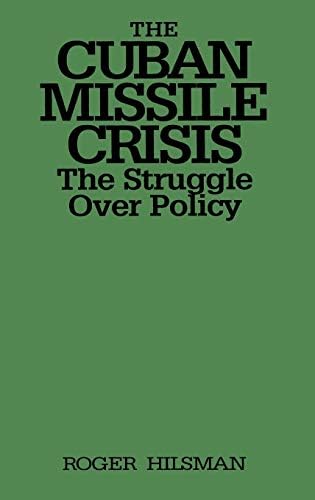
The Cuban Missile Crisis: The Struggle Over Policy
Product details
| Management number | 232042115 | Release Date | 2026/06/18 | List Price | US$29.48 | Model Number | 232042115 | ||
|---|---|---|---|---|---|---|---|---|---|
| Category | |||||||||
This book tells the story of the Cuban missile crisis in 1962, the struggle that President Kennedy and his advisers (including the author, who was head of intelligence at the State Department) went through to try to understand why the Soviet Union had put nuclear missiles in Cuba, the alternative policies they debated to deal with the presence of the missiles, the aftermath of the crisis, and the lessons learned about defense and foreign policy in an age dominated by intercontinental missiles tipped with nuclear warheads capable of obliterating the northern hemisphere. The purpose of the book is to focus the world's attention on the fact that something must be done—and soon—if we are to avoid Armageddon.The world has never been as close to nuclear war as it was in November 1962. In this book, Roger Hilsman, head of intelligence at the U.S. State Department at that time, details the struggles that President Kennedy and his advisers went through to understand why the Soviet Union had deployed nuclear missiles in Cuba, describes the debate over alternative policy choices to force the removal of the missiles, and determines how and why each particular course of action was eventually chosen. He relates how the U.S. government dealt with the public and with its allies, and traces the step-by-step negotiations between the Soviets and the United States. In his discussion, Hilsman reveals how Khrushchev chose a back-channel, deniable way of communicating with President Kennedy by sending messages to the head of the KGB in Washington, who passed them to Hilsman, who then took them to the president. This book shows how President Kennedy and his brother Robert used this information to bring about the withdrawal of the missiles without war.This book analyzes the motives behind the massive Soviet deployment of nuclear missiles to Cuba, which were capable of destroying every major city in the United States except Seattle, backed up by anti-aircraft and ground forces to defend those missiles. One ship could carry 20-to-30 freight-train loads of war materiel and over 100 shiploads were sent—a total of between 2,000 and 3,000 train loads. Hilsman tells the story of how American intelligence found out—just in time—and, in a post-mortem, addresses the question of U.S. success and/or failure. He concludes with an assessment of the significance of the only nuclear crisis in the world's history, pointing out the lessons for humankind about war in a nuclear age. Hilsman's book is one of only two accounts of the Cuban missile crisis written by one of the principals, and has added significance in light of the turbid state and uncertain future of nuclear weapons throughout the world. Read more
Bestseller ranking
1960s



Customers who viewed this product also viewed
Baltic States




Correction of product information
If you notice any omissions or errors in the product information on this page, please use the correction request form below.
Correction Request Form